People often inquire about this issue as E-2 visa, E2 visa, treaty investor visa, E-2 treaty countries, E-2 minimum investment, how much to invest for an E-2, E-2 business plan, or E-2 marginal enterprise. The E-2 visa is for nationals of treaty countries who make a substantial, at-risk investment in a real operating U.S. business and will develop and direct the enterprise (or qualify as an executive/manager/essential employee). Many E-2 cases turn on documenting lawful source of funds, showing the investment is irrevocably committed, presenting a credible business plan, and proving the business will not be marginal.

E-2 Visa Lawyer | Treaty Investor Visa, Requirements, Source of Funds & Renewals
E-2 Visa Lawyer | Treaty Investor Visa, Requirements, Source of Funds & Renewals
E-2 visa requirements (who qualifies for treaty investor status?)
To qualify for an E-2 visa, the investor and business usually must show several core things. People often ask us about this as E-2 visa requirements, who qualifies for an E-2 visa, E-2 substantial investment, E-2 source of funds, E-2 bona fide enterprise, or E-2 develop and direct.
1) The applicant must have the nationality of an E-2 treaty country
The E-2 visa is only available to nationals of countries that maintain the required treaty relationship with the United States. Treaty-country eligibility is the starting point in every E-2 case.
2) The investment must be substantial
There is no single fixed dollar amount that guarantees approval. Instead, the question is whether the investment is substantial in relation to the type and cost of the business. A stronger case usually shows a realistic budget and proof that meaningful funds have already been committed.
3) The funds must be lawfully obtained and clearly documented
One of the most important E-2 issues is source of funds. A strong case should clearly document where the money came from and how it moved into the investment. Common examples include business earnings, salary savings, sale of property, sale of a business, gifts, or loans secured by the investor’s personal assets.
4) The investment must be at risk and committed to the business
The money cannot just sit in a personal or business bank account. The investment should already be placed at risk for the purpose of generating profit, with evidence such as a lease, equipment purchases, inventory, payroll setup, build-out costs, vendor payments, or acquisition documents.
5) The business must be a real, operating, bona fide enterprise
A strong E-2 treaty investor visa case usually involves a real commercial business that is active or clearly launching with documented operations. A paper company or passive investment is usually not enough.
6) The investor must come to develop and direct the enterprise
A core E-2 requirement is that the investor will direct and develop the business. This is often shown through ownership, control, business planning, operational authority, and the investor’s active role in running or growing the enterprise.
7) The business cannot be marginal
A common E-2 concern is whether the business is only enough to support the investor and family. Strong cases show a credible path to more than minimal income through growth, staffing, recurring revenue, or broader economic impact.
8) If the applicant is an employee, the role must qualify
Some E-2 cases involve executives, managers, or essential employees of a qualifying treaty enterprise. In those cases, the company must still qualify, and the employee’s role must be clearly documented.
Common evidence used to prove E-2 visa requirements
Strong E-2 filings often include:
- passport evidence of treaty-country nationality
- company formation and ownership documents
- bank records and path-of-funds documentation
- tax returns, sale agreements, gift records, or loan documents showing lawful source of funds
- lease agreements, invoices, purchase receipts, payroll setup, and vendor contracts
- a detailed business plan with projections
- hiring plans, market evidence, and contracts showing the business is not marginal
Why these E-2 requirements matter
Most E-2 denials and delays happen because the case does not clearly prove:
- treaty-country nationality
- substantial investment
- lawful source of funds
- an at-risk and committed investment
- a bona fide operating enterprise
- that the investor will develop and direct the business
- that the enterprise is not marginal
- A well-prepared E-2 filing should explain these issues in plain English before getting lost in legal wording.

E2 Visa Details
The E2 visa is designed for aliens engaged in international investment between the United States and the alien’s country of nationality. E2 visa holders must make a active and substantial investment as well as perform an essential role in the enterprise that results in the creation of job opportunities for US workers. There is no set amount an E2 visa holder must invest as it depends on the type of enterprise. The E2 visa is initially valid for two years and may be extended indefinitely.
In order to qualify for an E2 visa, you must be a national of one of the following treaty countries. Spouses and children of E2 visa holders may enter and remain in the US in E2 status. E2 spouses may apply for and EAD. E2 spouses and children may attend school in the US.

For Whom Is an E2 Visa Appropriate?
- Executives, managers and specialists of a treaty nation company operating in the US seeking to enter to carry out substantial trade, including their family members;
- Companies in treaty countries who wish to send key personnel to set up a US company or manage the US affiliate or branch.

E2 Visa Requirements
An alien, if otherwise admissible, may be classified as a nonimmigrant treaty investor (E2) if the alien:
- Is a national of a treaty country;
- Makes a substantial investment which is not marginal; the percentage of investment in a high-cost enterprise.
- Is coming to the US to develop and direct the enterprise; and
- If the applicant is not the principal investor, he or she must be employed in a supervisory, executive, or highly specialized skill capacity.
Common E-2 treaty investor businesses (examples that often work when the investment and business plan are strong)
People often ask “what businesses qualify for an E-2 visa?” The E-2 category is less about the industry and more about whether the business is real and operating, the investment is substantial and at risk, the investor will direct and develop the enterprise, and the business is not marginal (it should generate more than minimal living for the investor and show credible growth/hiring).
Below are common E-2 business types that frequently qualify when structured and documented correctly.
Food, hospitality, and retail (very common E-2 models)
- Restaurant (fast casual, dine-in, specialty cuisine)
- Café / coffee shop / bakery
- Food truck (where permitted and properly licensed)
- Convenience store / specialty grocery / international market
- Liquor-adjacent retail where legal (non-controlled operations and proper licensing)
- Boutique retail (clothing, gifts, specialty goods)
- E-commerce brand with U.S. operations (inventory, warehouse, employees/contractors, marketing)
- Franchise restaurants and retail franchises (when the franchise and numbers support non-marginal operations)
Services businesses (popular because investment can be equipment + office + payroll)
- Staffing and recruiting firm (with compliant structure and real client contracts)
- Marketing agency / digital marketing / SEO agency
- IT services / managed services provider (MSP)
- Software services company with U.S. sales + operations (not just “a website”)
- Accounting/bookkeeping firm (where licensing and scope are appropriate)
- Business consulting firm with U.S. contracts and staffing plan
- Translation/localization agency
- Event planning and production company
- Photography/video production studio (commercial focus)
- Training/coaching business with facilities and documented revenue model
Health and wellness (common but licensing-heavy—plan carefully)
- Physical therapy clinic (licensed provider strategy required)
- Chiropractic clinic (licensed provider strategy required)
- Dental practice (licensed dentist ownership/operations planning)
- Medical spa (must be structured with proper medical oversight where required)
- Home health agency (licensed operations + staffing plan)
- Fitness studio (gym, yoga, Pilates, martial arts)
- Counseling/therapy practice (licensed provider strategy required)
Home and property services (strong when staffing and contracts are real)
- Residential/commercial cleaning company
- Janitorial services with recurring contracts
- Landscaping and lawn services with crews and equipment
- Pest control company (licensing and training requirements)
- HVAC company (licensed contractor strategy required)
- Plumbing/electrical contracting (licensed contractor strategy required)
- Painting company with crews and equipment
- Flooring/tile/renovation company (licensing and compliance planning)
- Property management company (state rules vary)
- Short-term rental management company (compliance and scale required)
Logistics, trade, and distribution (often strong with inventory and contracts)
- Import/export distribution company
- Wholesale distribution business (consumer goods, industrial supplies)
- E-commerce fulfillment / third-party logistics (3PL)
- Freight brokerage / logistics coordination company
- Last-mile delivery company with vehicles and contracts
- Warehousing and storage business
Manufacturing and product-based companies
- Light manufacturing or assembly business (facility + equipment + staffing)
- Packaging company
- Printing/signage business
- Private label product business with U.S. warehousing and distribution
- Specialty products company with recurring B2B purchase orders
Automotive and mobility businesses
- Auto repair shop (licensed mechanics + facility)
- Auto detailing and car wash
- Tire shop
- Trucking company (high compliance; must show real operations and staffing)
- Vehicle rental/leasing business (insurance/compliance planning)
Education and childcare
- Daycare/childcare center (licensing heavy; strong staffing plan required)
- Tutoring/learning center franchise
- Test prep and education services with facilities and staff
Common investor “situations” (addressed in E-2 filings)
- Buying an existing U.S. business for E-2 (“acquisition E-2”)
- Starting a new business (“startup E-2”)
- Purchasing a franchise
- Expanding a foreign company into the U.S. using an E-2 structure
- Using partial escrow structures (must still show funds committed and at risk)
What makes these E-2 examples work (the practical checklist)
Strong E-2 cases usually show:
- Lawful source of funds (clear path of funds documentation)
- Investment is at risk and committed (leases, equipment, inventory, payroll, vendor contracts, build-out)
- Real operating business activity (not just a plan on paper)
- Credible business plan with financial projections and hiring plan
- Not marginal: clear path to revenue growth and U.S. job creation or meaningful economic impact
- Investor will develop and direct the enterprise (or qualifies as executive/manager/essential employee)
How our firm helps E-2 businesses
We help E-2 clients by:
- Diagnosing whether the business model is E-2-ready (and fixing gaps before filing)
- Organizing source-of-funds and path-of-funds evidence
- Structuring the “at-risk” investment documentation (leases, invoices, payroll setup, vendor contracts)
- Drafting a credible business plan narrative tied to the numbers
- Addressing the marginal enterprise issue with a growth and hiring strategy
- Preparing interview-ready documentation and anticipating common officer concerns
E-2 minimum investment: how much do you need to invest?
One of the most common questions is “E-2 minimum investment.” There is not a single fixed dollar amount that guarantees approval. Instead, officers look at whether the investment is substantial in relation to the type of business and whether the business is real, operating, and capable of more than minimal activity.
Practical takeaways:
- Smaller businesses generally need a higher percentage investment relative to total cost (because the business must be credible and not marginal).
- Larger businesses may require higher total dollars, but the analysis still focuses on whether the investment is substantial for that business type and scale.
- The strongest cases show a complete, realistic startup or purchase budget and proof the investor has already committed funds.
“At risk” and “irrevocably committed” investment (what this means in real cases)
Many E-2 denials happen because the money is not actually committed to the business. The investment must be placed at risk for the purpose of generating a return and must be committed in a way that shows the business is already underway.
Common ways investors show funds are committed and at risk:
- Signed commercial lease and deposits paid
- Build-out/renovation payments and contractor invoices
- Equipment purchases (kitchen equipment, computers, vehicles, tools)
- Inventory purchases and supplier contracts
- Payroll setup and initial hiring costs
- Professional fees tied to business launch (licensing, insurance, legal/accounting) where appropriate
- Purchase of an existing business (asset purchase or stock purchase) with documented payment terms
Simply having money sitting in a bank account is usually not enough. The case is stronger when the business has already taken concrete, documented steps toward launch or operation.
Marginal enterprise (the #1 E-2 fear) and how to address it
A common question is “E-2 marginal enterprise.” In plain English, the business cannot be only a job for the investor with minimal income. The business should show credible capacity to generate meaningful income and/or create U.S. jobs and economic impact over time.
Common ways strong E-2 cases address marginality:
- A credible business plan with realistic financial projections
- A hiring plan showing U.S. workers and operational growth
- Signed contracts, purchase orders, letters of intent, or other market proof (when available)
- A business model that scales beyond the investor alone (staff, systems, recurring revenue)
E-2 vs E-1 vs EB-5 (which investor option fits your goal?)
A common question is “E-2 vs E-1” or “E-2 vs EB-5.” These options are built on different foundations.
- E-2 (treaty investor): based on a substantial, at-risk investment in a real operating U.S. business that the investor will develop and direct. E-2 is not a green card by itself, but it can be renewed if the business remains viable.
- E-1 (treaty trader): based on substantial trade and a continuing flow of transactions principally between the U.S. and the treaty country. If your business is mainly import/export or cross-border services with repeated transactions, E-1 may fit better.
- EB-5: an immigrant investor pathway with different investment thresholds and job creation rules. EB-5 is a green card category, not a temporary visa.
Choosing the right category depends on the investor’s treaty nationality, business model (trade vs investment), timeline goals, and whether the goal is a temporary visa or permanent residence.
E-2 treaty investor roles (owner/investor) vs E-2 employee roles
Some companies also bring E-2 employees. A common question is “E-2 essential employee” or “E-2 manager.”
Common E-2 employee roles include:
- Executive or manager: leads a major function, manages teams, or runs the U.S. operation
- Essential employee: has specialized knowledge critical to the enterprise’s success (for example, proprietary processes, specialized product knowledge, or key technical/operational expertise)
E-2 employee cases still require the company to be a qualifying treaty enterprise and the role must be clearly documented. Strong cases show why the employee’s skills are essential and why the business needs the person in the U.S.
Frequently asked questions about the E-2 treaty investor visa
What is an E-2 visa?
The E-2 visa is a treaty investor visa for nationals of treaty countries who make a substantial, at-risk investment in a real operating U.S. business and will develop and direct the enterprise (or qualify as an executive/manager/essential employee).
Is there an E-2 minimum investment amount?
There is no single fixed minimum investment amount that guarantees approval. The investment is evaluated based on the business type, total cost, and whether it is substantial and committed.
What does “at risk” and “irrevocably committed” mean for E-2?
It generally means the funds are committed to the business with real exposure to loss and are used for business purposes such as lease/build-out, equipment, inventory, and operating setup—not just sitting in a bank account.
What is a “marginal enterprise” and why does it matter?
A marginal enterprise is one that is not expected to generate more than minimal living for the investor. E-2 businesses should show credible capacity for meaningful income and/or job creation and economic impact over time.
What businesses commonly qualify for E-2?
Common E-2 businesses include restaurants, retail, service companies, logistics/distribution, franchises, light manufacturing, cleaning/landscaping, marketing/IT services, and other real operating businesses with credible budgets and growth plans.
Can I buy an existing business for an E-2?
Yes, many E-2 investors buy an existing U.S. business. The key is documenting the purchase, investment commitment, and a non-marginal operating plan.
Can I start a new business for an E-2 (startup E-2)?
Yes, but startup cases must show funds committed, operational readiness, and a credible plan showing the business will not be marginal.
What documents help prove source of funds for E-2?
Source of funds evidence typically shows lawful origin and a documented path of funds into the business, such as bank records, sale documents, tax records, and transfer documentation.
How long is an E-2 visa valid and can it be renewed?
Validity and renewal practices vary by country and case posture. Many E-2 visas can be renewed if the business remains viable and continues to meet E-2 requirements.
E-2 vs E-1: what’s the difference?
E-2 is based on investment in a U.S. business. E-1 is based on substantial trade principally between the U.S. and the treaty country.
E-2 vs EB-5: what’s the difference?
E-2 is a temporary treaty investor visa. EB-5 is an immigrant investor pathway with different investment and job creation rules and is designed for permanent residence.
What is the first step for an E-2 case?
Confirm treaty country eligibility and ownership/control, then build an evidence package showing lawful source of funds, funds committed and at risk, and a credible business plan addressing marginal enterprise concerns.
News Related to E2 VISA
| Date | Title | Details |
|---|---|---|
| September 20, 2024 | Department of State's Foreign Affairs Manual (FAM) | This section outlines the policies and procedures related to the issuance of E-2 visas, including definitions, qualifications, and application guidelines. |
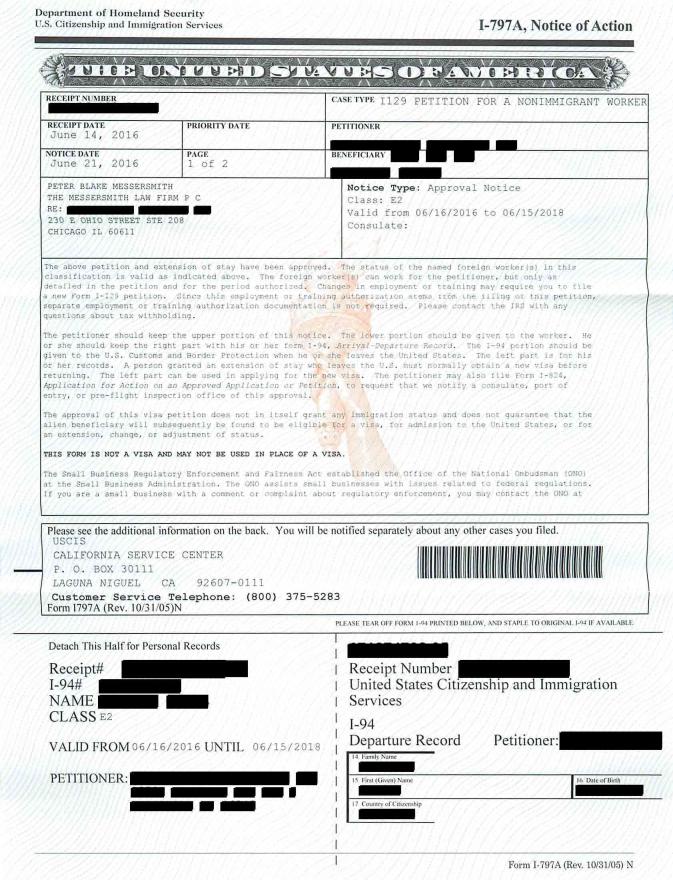
| June 13, 2023 | Employment Authorization for Certain H-4, E, and L Nonimmigrant Dependent Spouses | As of January 30, 2022, USCIS and U.S. Customs and Border Protection (CBP) began issuing Forms I-94 (Arrival/Departure Record) with new Class of Admission (COA) codes—specifically, "E-2S" for spouses. An unexpired Form I-94 reflecting this code serves as evidence of employment authorization for Form I-9 purposes. |
| March 17, 2022 | USCIS Updates Guidance on Employment Authorization for E and L Nonimmigrant Spouses | U.S. Citizenship and Immigration Services (USCIS) updated its policy to consider E-2 dependent spouses as employment authorized incident to their status, eliminating the need to apply separately for an Employment Authorization Document (EAD). |
| May 20, 2020 | USCIS Policy Manual | This section provides detailed guidance on the eligibility criteria, application process, and requirements for E-2 nonimmigrants. |