People often inquire about this issue as INA 212a2AiI, 212a2AiI, or Section 212a2AiI. These are shorthand references to INA § 212(a)(2)(A)(i)(I), the crime involving moral turpitude (CIMT) ground of inadmissibility, which can apply if a person is convicted of (or in some cases admits to) a CIMT.

INA 212a2AiI (INA 212(a)(2)(A)(i)(I)) — Crime Involving Moral Turpitude (CIMT)
INA 212a2AiI (INA 212(a)(2)(A)(i)(I)) — Crime Involving Moral Turpitude (CIMT)

What is a ground of inadmissibility?
In order for a foreign national to be admitted to the United States, he or she must be admissible. A foreign national can be deemed inadmissible to the United States by USCIS, CBP and a Consulate. If the foreign national is deemed inadmissible to the United States, he or she cannot enter without a waiver of inadmissibility or a determination that the inadmissibility charge was made in error.

212(a)(2)(A)(i)(I) Inadmissibility due to Crime Involving Moral Turpitude (CIMT)
Foreign nationals may be inadmissible due to the commission of a crime involving moral turpitude (CIMT). CIMT includes fraud, arson, blackmail, burglary, theft and others.
Any alien convicted of, or who admits having committed, or who admits committing acts which constitute the essential elements of a crime involving moral turpitude (other than a purely political offense) or an attempt or conspiracy to commit such a crime is inadmissible.
However it shall not apply to an alien who committed only one crime if the crime was committed when the alien was under 18 years of age, and the crime was committed (and the alien released from any confinement to a prison or correctional institution imposed for the crime) more than 5 years before the date of application for a visa or other documentation and the date of application for admission to the United States, or
the maximum penalty possible for the crime of which the alien was convicted (or which the alien admits having committed or of which the acts that the alien admits having committed constituted the essential elements) did not exceed imprisonment for one year and, if the alien was convicted of such crime, the alien was not sentenced to a term of imprisonment in excess of 6 months (regardless of the extent to which the sentence was ultimately executed).

How to obtain a determination that the 212(a)(2)(A)(i)(I) ground of inadmissibility was incorrectly made.
No matter which US government agency made the inadmissibility determination, each provides a method to dispute the determination, though each has drastically different processing times. We have achieved successful outcomes by petitioning the US Department of State where the determination was made by the Consulate in as little as 2 weeks. CBP quotes turnaround times of as little as 30 days and USCIS will not offer a time frame. In our experience, the more difficult the situation, the longer it will take to get resolved.
Common examples of crimes that may be treated as CIMTs under INA 212a2AiI
Whether an offense is a crime involving moral turpitude (CIMT) depends on the specific statute, its elements, and the record of conviction—not just the offense label. That said, the following categories are commonly analyzed as CIMTs:
- Theft offenses involving intent to permanently deprive (or similar intent elements), including certain shoplifting/theft statutes
- Fraud and deceit offenses (false statements, schemes to obtain a benefit through deception, wire/mail fraud-type conduct)
- Forgery, uttering, counterfeit-related offenses where intent to defraud is an element
- Identity theft or impersonation offenses involving deceit or intent to defraud
- Check fraud and related financial deception offenses
- Credit card fraud and access device fraud offenses
- Insurance, benefits, or immigration-related fraud offenses
- Perjury and false swearing offenses (and certain obstruction offenses where deceit is an element)
- Bribery offenses and corruption-type crimes involving dishonest intent
- Certain assault or battery offenses that require intent to cause serious bodily harm (or other aggravated intent elements)
- Certain domestic violence-related offenses depending on the statutory elements and intent requirement
- Child abuse or child endangerment offenses in some jurisdictions (highly statute-specific)
- Certain sex offenses depending on the statutory elements
- Certain burglary offenses where the statute requires intent to commit a CIMT inside (statute-specific)
- Certain drug paraphernalia / controlled substance offenses are often analyzed under different grounds, but some may still raise CIMT arguments depending on the exact statute and record
Important: many people wonder “Is DUI a CIMT?” Many simple DUI offenses are not treated as CIMTs, but the analysis can change with aggravating factors (for example, driving on a suspended license, injury, child endangerment, or other intent-based components) and the specific statutory elements.
Also, “CIMT” outcomes can differ across states because statutes are written differently. The correct approach is to analyze the exact statute of conviction (or charge), the disposition, the record of conviction (charging document, plea, judgment), and the sentence to determine CIMT consequences and whether the petty offense exception, juvenile exception, or a waiver may apply.
Petty offense exception for INA 212a2AiI (CIMT)
Not every CIMT makes a person inadmissible. A common exception is the “petty offense exception,” which may apply when there is only one CIMT and the offense is minor enough under the statutory criteria.
In general terms, the petty offense exception may apply where:
- The person committed only one CIMT; and
- The maximum possible penalty for the offense does not exceed one year; and
- The person was not sentenced to more than six months of imprisonment (regardless of how much time was actually served).
Whether the petty offense exception applies depends on the exact statute of conviction, the maximum possible penalty under that statute, and the actual sentence imposed. A careful analysis of the criminal statute and certified court records is critical.
Juvenile exception for INA 212a2AiI (CIMT)
Another important exception is the “juvenile exception,” which can apply when the CIMT conduct occurred while the person was under 18 and enough time has passed before the person applies for a visa or admission.
In general terms, the juvenile exception may apply where:
- The person committed only one CIMT; and
- The CIMT was committed while the person was under 18 years old; and
- The person was released from any resulting confinement (if any) more than five years before applying for a visa or admission.
This analysis is highly fact-specific and depends on the age at the time of the offense, the case disposition, and the timing of the application. Certified records and a clear timeline matter.
212(h) waiver for INA 212a2AiI (CIMT)
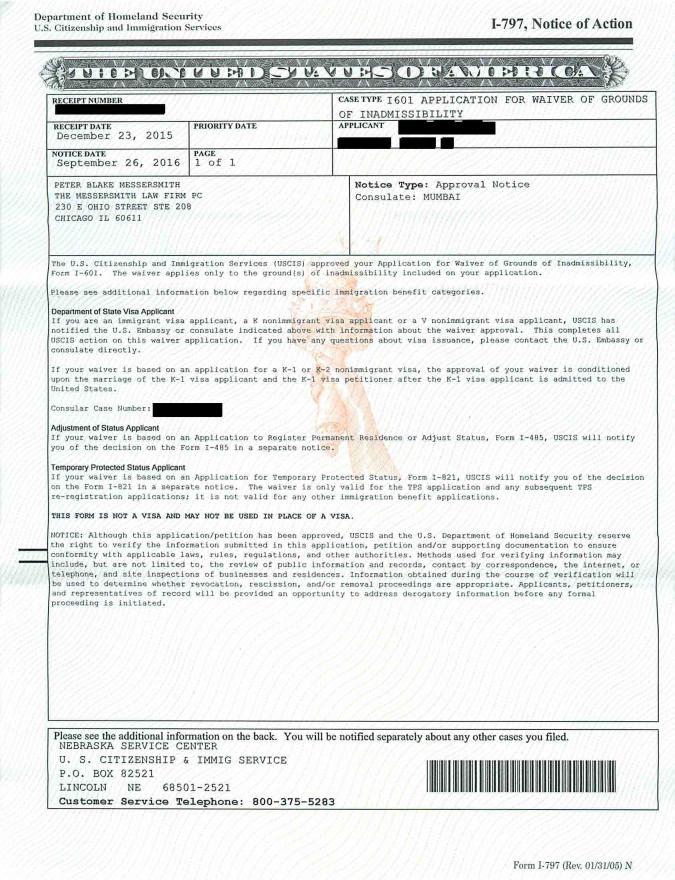
In some cases, a person who is inadmissible for a CIMT under INA 212a2AiI may seek a waiver under INA 212(h). Whether 212(h) is available depends on the person’s immigration posture, criminal history, and statutory eligibility requirements.
In general, 212(h) waiver cases are typically built around:
- Proving statutory eligibility (including any required qualifying relative or other eligibility pathway, depending on the case)
- Demonstrating rehabilitation and positive discretionary factors
- Presenting hardship evidence where the statute requires it
- Showing that the applicant merits a favorable exercise of discretion
Because 212(h) is fact-specific and can be limited by criminal history and other factors, the first step is a careful review of the statute of conviction, the sentence, and the person’s full immigration history.
Frequently asked questions about INA 212a2AiI (212(a)(2)(A)(i)(I))
What is INA 212a2AiI?
INA 212a2AiI (INA 212(a)(2)(A)(i)(I)) is the inadmissibility ground for crimes involving moral turpitude (CIMTs). It can apply when a person is convicted of a CIMT or, in some situations, when a person makes a legally valid admission to committing the elements of a CIMT.
What is a crime involving moral turpitude (CIMT)?
A CIMT is a category of offenses that typically involves intent-based wrongdoing such as theft with intent to permanently deprive, fraud/deceit, or other conduct viewed as inherently dishonest or morally blameworthy. Whether an offense is a CIMT depends on the statutory elements and the record of conviction, not just the offense name.
Does a CIMT make someone inadmissible automatically?
Not always. Even where an offense is a CIMT, an exception may apply (for example, the petty offense exception or juvenile exception). The outcome depends on the statute, the record of conviction, the sentence, and whether there are multiple offenses.
What is the petty offense exception for INA 212a2AiI?
In general terms, the petty offense exception may apply where there is only one CIMT, the maximum possible penalty does not exceed one year, and the sentence imposed was not more than six months. Whether it applies requires confirming the maximum possible penalty under the statute and the actual sentence imposed using certified records.
What is the juvenile exception for INA 212a2AiI?
In general terms, the juvenile exception may apply where there is only one CIMT committed while the person was under 18 and the person was released from any resulting confinement more than five years before applying for a visa or admission. Timing and certified records matter.
Is DUI a CIMT?
Many simple DUI offenses are not treated as CIMTs. However, the analysis can change with aggravating factors or different statutory elements, so a statute-by-statute review is essential.
What if there was no conviction—can a person be inadmissible for CIMT anyway?
Sometimes. INA 212a2AiI can also be triggered if a person makes a legally valid “admission” to committing the essential elements of a CIMT. Whether an admission is legally valid is technical and fact-specific, and it often depends on what was asked, what was admitted, and the legal elements of the offense.
Does expungement or dismissal remove CIMT inadmissibility?
Not necessarily. Immigration consequences often do not track state expungement terminology. The key questions are the legal disposition, whether there is still a conviction for immigration purposes, and what the record of conviction shows.
What documents are needed to analyze whether my offense is a CIMT?
At minimum, you typically need certified records, including the charging document, plea agreement or transcript, judgment/conviction record, and sentencing order. A complete timeline and the statute text (including the version in effect at the time) are also important.
Can INA 212a2AiI be waived?
In some cases, a waiver may be available (commonly analyzed under INA 212(h)), but eligibility is fact-specific and depends on immigration posture, criminal history, and statutory requirements. The first step is a full review of the statute of conviction, the sentence, and the person’s immigration history.
News Related to INA § 212(a)(2)(A)(i)(I)
| Date | Title | Details | ||
|---|---|---|---|---|
| August 22, 2024 | Department of State's Foreign Affairs Manual (FAM) | The Department of State's FAM offers guidance to consular officers on determining visa ineligibilities due to criminal activities, including CIMTs. | ||
| May 26, 2021 | USCIS Policy Manual | U.S. Citizenship and Immigration Services (USCIS) updated its Policy Manual to provide detailed guidance on offenses considered CIMTs. | ||
| August 6, 2018 | Matter of Agustin ORTEGA-LOPEZ | The BIA clarified that for an offense to be classified as a CIMT, it must involve both a culpable mental state and reprehensible conduct. | ||
| October 31, 2010 | 212(a)(2)(A)(i)(I) Crime Involving Moral Turpitude or CIMT | What is INA 212(a)(2)(A)(i)(I) Crime Involving Moral Turpitude or CIMT |