People often inquire about this issue as J-1 waiver, INA 212(e), 212(e), or the two-year home residency requirement (the J-1 two-year rule). These are shorthand references to the INA 212(e) home-country physical presence requirement, which can restrict certain J-1 exchange visitors from changing status in the U.S. or obtaining certain visas or permanent residence unless the requirement is satisfied or a J-1 waiver is granted.

J-1 Waiver (INA 212(e)) — Two-Year Home Residency Requirement
J-1 Waiver (INA 212(e)) — Two-Year Home Residency Requirement
Am I subject to INA 212(e) (the J-1 two-year rule)?
Not every J-1 exchange visitor is subject to INA 212(e). The two-year home residency requirement commonly applies when one or more of these situations are present:
- Government funding: the J-1 program was funded in whole or in part by the U.S. government, the visitor’s home government, or an international organization
- Skills list: the visitor’s field of study or training appears on the Exchange Visitor Skills List for the visitor’s country
- Graduate medical education/training: the visitor came to the U.S. for medical residency or fellowship training in J-1 status
The fastest way to confirm 212(e) is to review the DS-2019, the J-1 visa foil annotation, and the program record. If the visa says the person is “subject,” that is a strong indicator, but the underlying program facts still matter.
How to apply for a J-1 waiver (DS-3035, Waiver Review Division, and Form I-612)
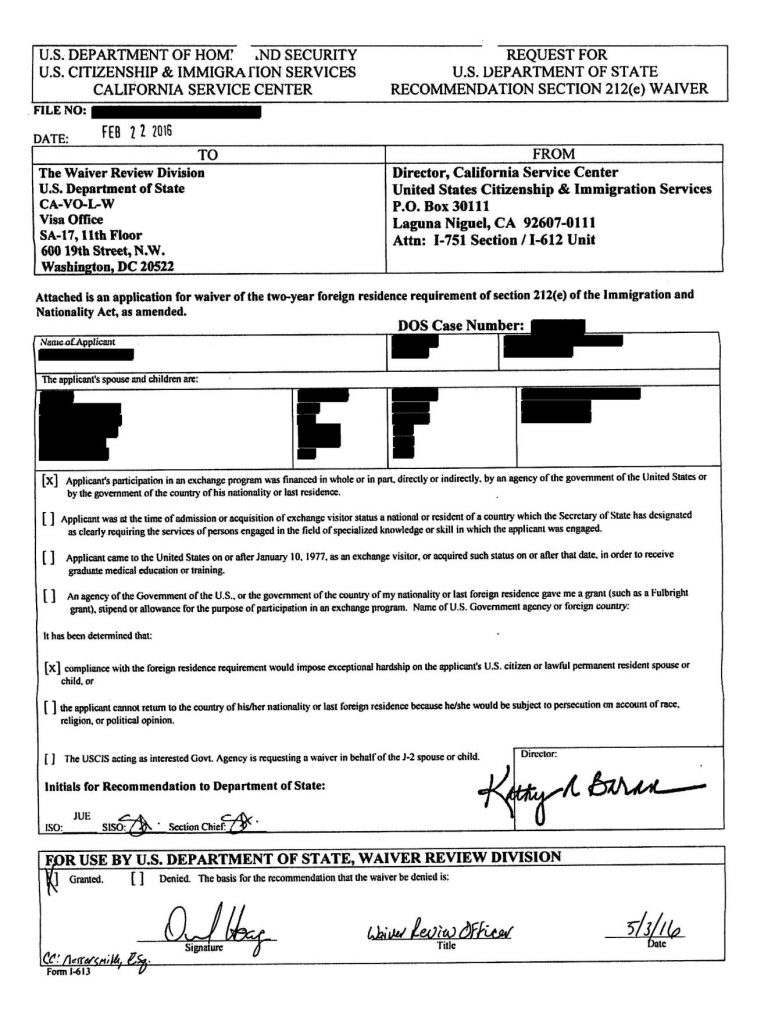
Most J-1 waiver cases start with Form DS-3035 (J-1 Visa Waiver Recommendation Application) through the U.S. Department of State’s Waiver Review Division. The waiver basis determines what additional documents are required and which agency provides the recommendation.
Some waiver bases (such as exceptional hardship and persecution) also require Form I-612 to be filed with USCIS as part of the process. Because procedures differ by waiver type, the first step is identifying the correct waiver basis and building a clean document checklist for that basis.

J1 Waiver Details
A J1 visa holder who is subject to INA §212(E) must either return to his or her home country upon expiration of the J1 visa or obtain a J1 waiver before he or she may change his or her status to H1B visa, L1 visa or adjust their status to permanent resident (green card).
INA §212(E)
Exchange visitors may be subject to the two-year foreign residence requirement of Section 212(e) of the Immigration and Nationality Act for one or more of the following reasons:
- They received funding from the United States Government, their own government, or an international organization in connection with their participation in the Exchange Visitor Program.
- The education, training, or skill they are pursuing in this country appears on the Exchange Visitor Skills List for their country.
- They acquired J1 status on or after January 10, 1977, for the purpose of receiving graduate medical education or training.
If a participant in an exchange program is subject to the two-year foreign residence requirement, his or her spouse and unmarried minor children who were admitted as exchange visitors or acquired such status after admission are also subject to this requirement.
If you are unsure if you are subject to §212(e), you may obtain an advisory opinion from the government. This advisory opinion is authoritative. If your DS-2019 form states that you are subject to §212(e) then you are subject to §212(e). However, if your DS-2019 form does not state that you are subject to §212(e), you may still be subject to §212(e).
Exchange visitors who are subject to, but do not wish to comply with, the two-year home country residence requirement, may apply for a J1 waiver of that requirement under any one of the five applicable grounds provided by the United States immigration law.

For Whom Is a J1 Waiver Appropriate?
J1 visa holders who are subject to the two year home residency requirement but who do not wish to comply with that requirement so they may remain in the United States and obtain an H or L visa or permanent residency.

J1 Waiver Requirements
Varies.
No Objection Statement (NOS) J-1 waiver
A No Objection Statement waiver is based on a statement from the J-1 visitor’s home government indicating it does not object to the visitor receiving a waiver of the two-year home residency requirement. This waiver type is not available in every situation, and eligibility depends on the program and funding facts.
Interested Government Agency (IGA) J-1 waiver
An Interested Government Agency waiver is based on a U.S. government agency’s request that the J-1 visitor receive a waiver because the agency believes the visitor’s work or presence in the United States is in the public interest. These cases are evidence-heavy and often depend on a strong agency support letter and record.
Conrad 30 J-1 waiver (physicians)
Conrad 30 is a physician-specific J-1 waiver pathway tied to working in designated shortage areas and meeting program requirements. These cases are highly time-sensitive and documentation-driven.
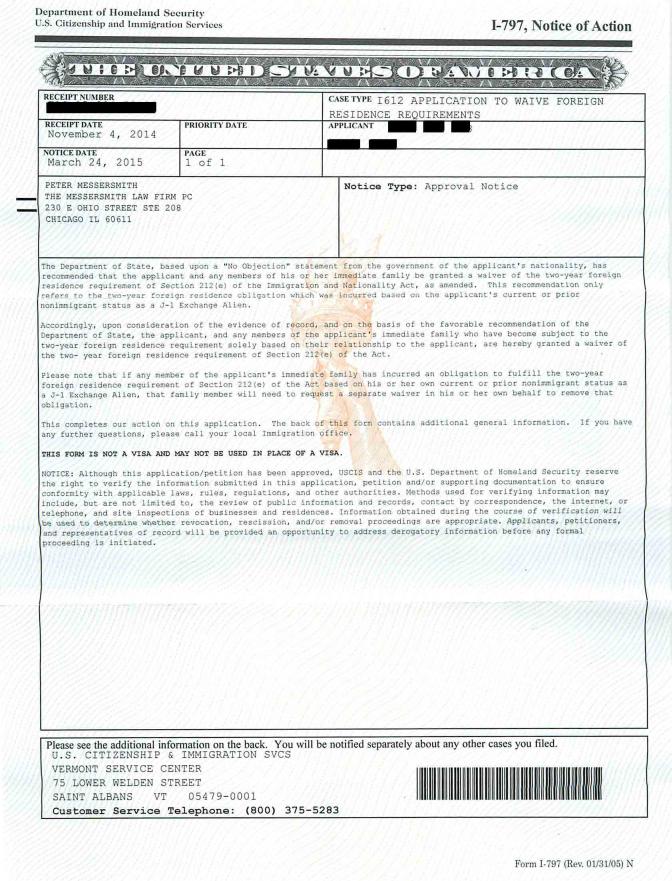
Exceptional hardship J-1 waiver (Form I-612)
An exceptional hardship waiver is based on showing exceptional hardship to a qualifying U.S. citizen or lawful permanent resident spouse and/or child if the J-1 visitor must satisfy the two-year requirement abroad. These cases typically involve Form I-612 and a detailed hardship evidence package.
Persecution J-1 waiver (Form I-612)
A persecution waiver is based on showing the J-1 visitor would face persecution in the home country on account of race, religion, or political opinion. These cases typically involve Form I-612 and a strong record supporting the persecution claim.
Frequently asked questions about the J-1 waiver (INA 212(e))
What is the J-1 two-year home residency requirement (INA 212(e))?
INA 212(e) is the two-year home-country physical presence requirement that applies to certain J-1 exchange visitors. If it applies, it can block changing status in the U.S. or getting H, L, K visas or permanent residence unless the requirement is satisfied or waived.
How do I know if I am subject to 212(e)?
Check your DS-2019 and your J-1 visa annotation. Even if the visa says “subject” or “not subject,” the underlying program facts still matter.
What are the most common reasons someone is subject to 212(e)?
The most common triggers are government funding, the Exchange Visitor Skills List, and J-1 graduate medical education or training.
Does government funding automatically trigger 212(e)?
Often, yes when the program is funded in whole or in part by a U.S. government, foreign government, or international organization. The details in the program record matter.
What is the Exchange Visitor Skills List?
It is a list of fields tied to specific countries where the U.S. expects the participant to return and use their skills. If your field and country match the list, 212(e) may apply.
What does “D/S” mean and does it relate to 212(e)?
D/S means “duration of status” on an I-94 for certain categories. It is separate from 212(e), which is a J-1 home residency rule.
Can the visa annotation be wrong about whether I’m subject to 212(e)?
Yes, errors happen. If the record is wrong, the issue is usually addressed by documenting the correct basis and pursuing the appropriate correction process.
What is a J-1 waiver?
A J-1 waiver is the process used to waive the two-year home residency requirement so the person can pursue certain immigration benefits without completing two years abroad.
What are the five main J-1 waiver bases?
The common waiver bases are No Objection Statement (NOS), Interested Government Agency (IGA), Conrad 30 (physicians), exceptional hardship, and persecution.
What is Form DS-3035?
DS-3035 is the J-1 Visa Waiver Recommendation Application used to start most J-1 waiver cases through the Department of State’s Waiver Review Division.
What is the Waiver Review Division?
It is the U.S. Department of State office that reviews J-1 waiver cases and issues a recommendation to USCIS (or to the agency process depending on waiver type).
What is Form I-612?
Form I-612 is filed with USCIS in exceptional hardship and persecution waiver cases.
Can I file a J-1 waiver from inside the United States?
Yes, many people apply from inside the U.S. The key is choosing the correct waiver basis and following the DS-3035 and/or I-612 process for that basis.
Can I apply for an H-1B if I am subject to 212(e)?
Not unless you satisfy the two-year requirement or obtain a J-1 waiver. The 212(e) rule commonly blocks H status until resolved.
Can I apply for a green card if I am subject to 212(e)?
Being subject to 212(e) can block adjustment of status and immigrant visa processing in many cases until the requirement is satisfied or waived.
How does the No Objection Statement (NOS) waiver work?
NOS is based on a statement from the home government indicating it does not object to the waiver. Eligibility depends on the program facts and whether NOS is allowed for the case.
Who sends the No Objection Statement?
Typically the applicant’s home government (often through an embassy/consulate process) sends it to the Department of State.
When is a No Objection waiver not available?
NOS is commonly not available in certain government-funded or physician training situations. Eligibility depends on the exact program and category.
How does an Interested Government Agency (IGA) waiver work?
An IGA waiver is based on a U.S. government agency requesting the waiver because it believes the applicant’s work or presence is in the public interest.
What evidence is important for an IGA waiver?
The agency support letter is central, along with documentation showing why the applicant’s continued work is important and aligned with the agency’s mission.
What is a Conrad 30 J-1 waiver?
Conrad 30 is a physician-specific waiver program tied to working in designated shortage areas and meeting program requirements.
Who qualifies for a Conrad 30 waiver?
It applies to certain J-1 physicians who agree to work in an eligible area and satisfy program and employment requirements. The details depend on the state program and filings.
What is an exceptional hardship J-1 waiver?
It is a waiver based on exceptional hardship to a qualifying U.S. citizen or lawful permanent resident spouse and/or child if the applicant must complete the two-year requirement abroad.
What counts as exceptional hardship for I-612?
Hardship is fact-specific and often includes medical, financial, family, educational, and country-conditions factors tied to separation and/or relocation.
What is a persecution J-1 waiver?
It is a waiver based on showing the applicant would face persecution in the home country on account of race, religion, or political opinion.
Can I switch waiver bases after filing?
Sometimes, but it can affect timelines and documentation requirements. It’s best to choose the correct basis early.
How long does a J-1 waiver take?
Processing times vary widely by waiver type and case completeness. The best way to avoid delays is a complete, well-organized submission.
What are common reasons J-1 waiver cases get delayed?
Missing documents, incomplete DS-3035 packages, weak agency letters, unclear timelines, or inconsistencies across records are common delay drivers.
What documents should I gather before starting?
DS-2019s, passport biographic page, I-94, J-1 visa, any funding documentation, program details, and a clean timeline are common starting documents.
What is the most important first step?
Confirm whether 212(e) applies and which trigger applies (funding, skills list, or physician training), then choose the correct waiver basis and build the checklist for that basis.
News Related to INA § 212(e)
| Date | Title | Details | ||
|---|---|---|---|---|
| December 9, 2024 | Public Notice of Revised Exchange Visitor Skills List | The Department of State is announcing an update of the Exchange Visitors Skills List. | ||
| September 11, 2024 | Department of State's Foreign Affairs Manual (FAM) | The Department of State's FAM provides insights into the discretionary authority to recommend waivers for nonimmigrants whose cases meet certain criteria. | ||
| October 24, 2023 | USCIS Policy Manual Update on Foreign Residence Requirement | U.S. Citizenship and Immigration Services (USCIS) updated its Policy Manual to provide clearer guidance on determining whether exchange visitors have fulfilled the two-year foreign residence requirement. |